

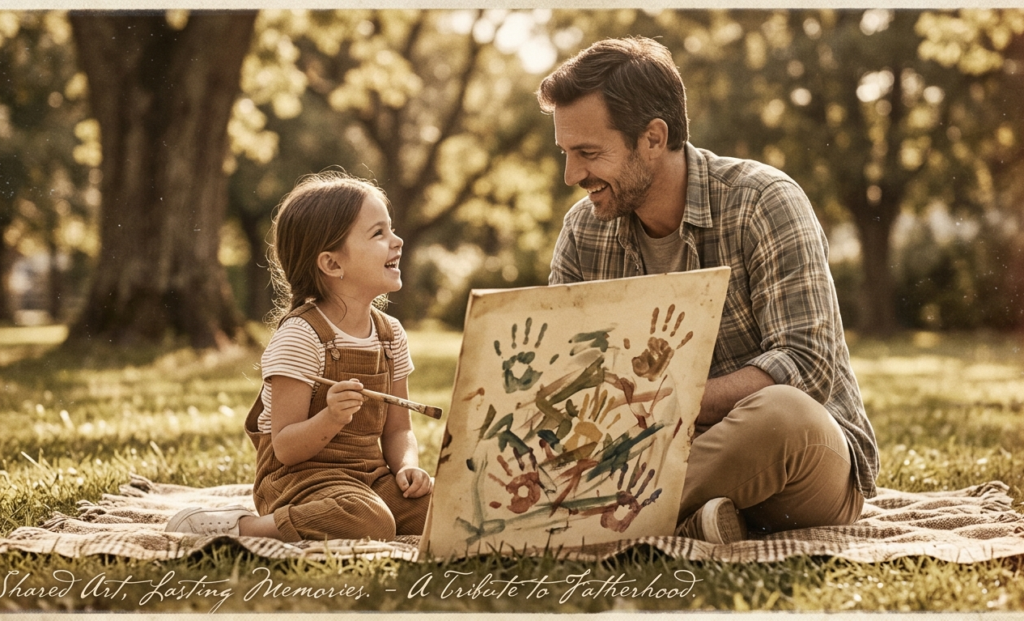
As we approach Father’s Day in June, and the kids are out of school looking for things to do, I want to give a shout out to dads, the important job they do as parents, and propose some joint art-making.
When I was growing up my dad was the nurturer in our family and having a scientific mind, he often took my brother and I out to natural areas to look for bugs, butterflies, and frogs with the goal of finding something unique, examining it, identifying it, and setting it free. Perhaps I inherited the thrill of the seek and find from him as a scientist and nature lover genetically, but I feel his presence and the time he took to be with us on these adventures is truly the thing that impacted and inspired me the most. Research supports the important role of fathers in young children’s lives, and multiple studies conclude the more a father is involved in a child’s life the greater the positive effects are on the child’s mental, cognitive, social, and physical outcomes.
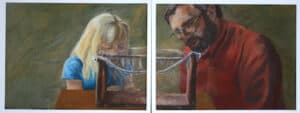
(Chalk pastel image I illustrated from a story I wrote about a father and daughter relationship.)
Precious core memories are built anytime a parent spends time having fun with a child, whether it be a vacation, a game played, or a shared creative activity. It is easy to get caught up in the hustle and bustle of everyday life, and that’s why the moments that are different stand out so much more. As an art therapist I’d like to propose some art-making activities you can try with your child to enhance your child’s growth and foster those core memories of parent/child bonding.
One process studied in the literature and that I use often in my practice is the Joint Painting Procedure. This requires parent and child to paint together on the same paper or canvas. Each person creates their own painting space, marking it off with a border, and paints whatever they like. Next the parent and child stand back to look at what each has made. After some thought and discussion each person creates a pathway from their art to the other person’s artwork. Once the pathways are created, parent and child decide together what to do with the remaining space on the canvas or paper, determine roles of who will do what, and together they complete the painting. The process creates a bond between the adult and child, helps both parties better learn problem solving with each other, and how to share space.
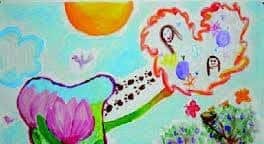
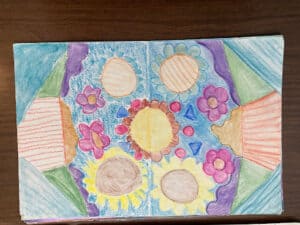
Another option is to play a bilaterally stimulating game where parent and child sit across from each other, folding a large piece of paper in half. Each person takes a turn creating a shape or an object that the other person will attempt to mirror and copy. If the child goes first and draws a triangle, the parent copies the triangle’s mirror image and adds a rectangle. The child then copies the rectangle the parent drew and adds a new element of their own. Continue until all the white space is filled. This process fosters turn-taking, observing, receptive communication skills, and stimulates both sides of the brain creating new neuropathyways between brain hemispheres.
A third option is to go on a nature walk together, gathering found objects to make something creative with when you get back home. Additionally, even taking the time to scribble and then trying to make sense of the scribble can become a story-telling adventure. In reality it doesn’t really matter what activity you do together as long as you do it together. The great D. W. Winnicott wrote in his book “Playing and Reality” about the importance of play and the “good enough parent”, meaning that parents don’t always have to get it right as long as they try.
Carr, S., & McDonald, A. (2019). The power of the art: The importance of images in art therapy
literature. International Journal of Art Therapy, 24(4), 149–150.
https://doi.org/10.1080/17454832.2019.1678252
Choi J, Kim HK, Capaldi DM, Snodgrass JJ. Long-term effects of father involvement in childhood on their son’s
physiological stress regulation system in adulthood. Dev Psychobiol. 2021 Sep;63(6):e22152. doi:
10.1002/dev.22152. Epub 2021 Jun 14. PMID: 34124784; PMCID: PMC8923429.
Gavron, T., & Mayseless, O. (2015). The Joint Painting Procedure to Assess Implicit Aspects of the Mother–Child
Relationship in Middle Childhood. Art Therapy, 32(2), 83–88. https://doi.org/10.1080/07421656.2015.1028007
Franklin, M. (2010). Affect Regulation, Mirror Neurons, and the Third Hand: Formulating Mindful
Empathic Art Interventions. Art Therapy, 27(4), 160–167.
https://doi.org/10.1080/07421656.2010.10129385
Winnicott, D.W. (1971). Playing and Reality. Routledge.